dp movement 다시 한번 요약하자면...

DPs were moved from the position where they got a "theta role" to a position where they could get "case".


let's turn to another kind of phrasal movement, where DPs already have Case.


question들의 종류 중 두 가지 알아보자

1) yes/no question : the answers to theses questions ; yes, no, maybe, i dont know...

2) wh-question : the words that introduce them begin with letters <wh> in Eng( except "how")

the responses to this kind of question must be "informative phrases".


1. movement in wh-questions

wh-question들 보면,,,

1) you can see that wh-phrase appears in a position "far away from" the position where its "theta role" is assigned. = not in their theta positions.

2) wh-phrases aren't in their Case positions. Case부여하는 자리에 없음

What did Becky buy? --> what 이 theme인데, theta position이자 case부여하는 buy뒤가 아니라 구의 맨 앞에 온다. 

What did Stacy say Becky bought? --> bought의 theme인 what이 너무 멀리 있어서 locality constraint위반처럼 보인다


우리는 앞과는 다른 trigger를 가지고 이동이 일어난다고 볼 수 있다.

결론부터 말하자면, wh-phrases move to "specifier of CP".

specifier of CP인 이유 : wh-phrases는 aux C보다 앞에 나오는데, 그러면 들어갈 자리가 CP의 spec자리밖에 없음.


*notice that what moves is "an entire phrase; DP, PP, AdjP, AdvP" 따라서 head-to-head movement라고 볼 수 없다.


그리고 이 이동은 main clause에서 T->C movement도 일으킨다(의문문인데 C가 null값이니까..(?))


the only complementizer that is compatible with wh-movement in English is null. O/[+Q, +WH]로 나타낼 수 있을듯(?)

어느 언어든, [+WH] resides in the C of a wh-sentence.

and wh-phrase moves to the specifier of CP "to be near the [+WH] feature. = "to check the wh-feature" (DP이동도 [NOM]feature check위해 이동했듯이!


369~375 예시 꼭 살펴보자!


*whom 목관대는 초기 생성 자리에서 theta role이랑 case받고, [+WH] feature check위해 이동하는 것이다!


+간접의문문이라고 우리가 부르는, wh-questions in embedded clauses는 T->C이동이 일어나지 않는다.

즉, C가 [+Q, +WH]가 아님. C[+Q]를 포함 안하는듯!  e.g., I wonder what she has done. *I wonder what has she done.


*wh-phrase가 문두에 오는 경우도, embedded clause의 맨 앞 정도에만 오는 경우도 있다. 이건 동사 바이 동사인데, think의 CP의 subcategory는 headed by C[-Q, -WH] ; who do you think N kissed? / wonder는 C[-Q, +WH] ; I wonder who N kissed.


2. Relative Clauses

Relative Clause : a CP with a wh-element in it modifies a noun. 관계절이라고 생각하면 될듯

wh-movement의 약간 특이 케이스(?)


+명사 꾸며주는 절이라고 다 relative clause인 것은 아님

Factive complement clause라는 구도 있다 ; 동격의 절 정도라고 생각하면될 것 같은데, factive에 해당하는 단어들은 CP를 adjunct가 아니라 "complement"로 받는다(관계절은 adjunct로 받는듯?)

특징 : don't have missing elements in the TP(완전한 문장이 C뒤에 온다는 말인듯). / there are no wh-phrases / they have all of their arguments contained within them(이건 뭔소린지 ㅁㄹ)

e.g., [(DP) The fact [(CP) that I like milk shakes]] is none of your business.


관계절은 이와 달리, share with wh-questions the property of having an argument or adjunct missing within the clause. 뒷문장 불완전한 채로 adjunct로써 쓰인다는 뜻..? argument는 어캐 해석하지..


위에서 본 embedded wh-question과 다른 점은 the category the CPs are attached to이다. 

간접의문문은 part of VP, 관계절은 part of DP. 


예시 tree:30번트리 첨부

*보면, wh-phrases를 embedded CP의 specifier로 옮긴다.


그런데, 모든 관계절에 wh-element가 있는 것은 아니다 ; I know several people __ she kissed.

--> 그리고, several people은 누구로부터 theta role을 받아올까? know라는 동사로부터 "theme role"받아오는 동시에, kissed라는 동사로부터도 theme role을 받는 것으로 보인다.

즉, a single noun gets two theta roles from two different verbs! theta criterion에 어긋난다..

해결방법 : English has a special DP element called an "operator"! Operator이 따로 있다고 생각해보자.

그리고 이 Op가 원래 Case position(kissed의 목적어)에서 시작해, wh-phrase가 그러듯이 spec CP자리로 이동한다.

I know several people [(CP) "여기로이동!" [(TP) she kissed Op] ].

이렇게 하면, 하나의 명사가 두 곳에서 theta role받는 것이 아니라, 두개의 명사가 각각 theta role받아온다고 말할 수 있다!(peopel은 know로부터, Op는 kissed로부터)

보다시피, Op는 silent하다. (그냥 wh-phrase가 silent한 버전=Op라고 생각하면 될듯)


또, wh-element대신에 that이 나오는 경우도 있다. ;  I know several people that she kissed.

--> we have a null "wh-word" that moves into the specifier of the CP headed by that

;  I know several people ["여기로 이동!" that [she kissed Op] ]. 

영어 고어나 다른 언어들에서 who that 이런식으로 같이 붙여쓰는 게 이 주장의 증거가 됨. 영어만 wh, that 둘이 같이 쓰면 silent되는 것임!


3. Island

Wh-movement 등 여러 이동은 사실 제약이 존재한다. 그 제약은 "island"와 관련있다.

Island... you cannot move out of an island, but you can move around within it.


#크게 네 가지 island가 있다

1) DP-island

CP가 N head의 complement일 때, DP밖으로 이동불가. 

CP는 완전한 절, 관계절 둘다 해당

"What" did lori make [(DP) the claim [ (CP) that she read "t i" in the syntax book] ]?

"Which cake" did you see [(DP) the woman [(CP) who baked "t i" ] ]?


The complex DP constraint : *wh i [...[(DP)... t i ...] ...]


2)wh-island

wh-phrases를 둘 다 옮기려 하게 되면 문제가 생긴다. 

once you move a wh-phrase into a specifier of a CP, then that CP becomes an "island" for further extraction.

= you can't do wh-movement and skip around a CP that has another wh-phrase in its specifier.

첫번째꺼 옮기면서 island형성되면, 첫번째가 들어간 spec CP 건너뛰면서 다른 거 밖으로 빼내고자 할 수 없다.(4번 섹션과 관련있음)


43번,46번 문장 첨부(문장이 각각 존재할 때는 괜찮은데 합치면 참사 발생..!)

- How do you think Franz bought what? / I wonder what Franz bought how. 이렇게 이동이 하나만 일어나는 경우는 괜찮아!


Wh-island constraint : * wh i [... [ (CP) wh k [ ... t i ...] ...] ...]


3) subject island

the subject condition : *wh i ... [TP [ CP(주어) ... t i ... ] T ...]

* "Who i" was [(TP) [(CP) that the police would arrest "t i" ] "t was" a certainty?


4) conjunction

51번 첨부

53번 첨부


4. The minimal link condition(MLC)

4.1 wh-island and MLC

앞에서 여러번 봤듯이, syntactic operations like to either be local(anaphor within clause, theta roles within VP) or create localities(DP close to Case assigner, affix close to their host, wh-phrase near [+WH])

WH-이동 역시 마찬가지다. "Movement must always target the nearest potential position" --> locality condition


MLC = move to the closest potential landing site.

383 57부터 59까지 읽어보기!

요약 : wh-phrase가 두 개 나오게 되면, 이동 가능한 가장 가까운 자리가 겹치게 됨. 하나가 채우게 되면, 다른 하나는 스킵하고 다른 이동가능한 자리로 넘어가게 되는데, 그렇게 되면 [+WH] feature check는 가능해도 MLC만족못함.


*when you have multiple wh-phrases that require movement, movement of at least one of them will be blocked by the MLC because the closest potential landing site will be occupied by the other.


- "Who" do you think "t i" kissed the gorilla? 이거 MLC위반 아니야 그럼?

우리 저번에 wh 이동이 한방에가 아니라 들렀다가 간다고 했던거 기억나? 중간에 들르는 이유가 MLC때문인 것이다.

the MLC requires that all movement be local. in order to maintain this locality the movement happens in two hops. --> "successive cyclic movement" 

MLC때문에 들렀다가 [+WH]feature checking? 암튼 어떤 이유로 최종자리로 정착하러 한번 더 올라간다.

62번 첨부


4.2 the MLC in DP movement and Head Movement

MLC, 다른 island에 대해서는 설명 못함. 아직도 논란 중..

대신 DP movement랑 head movement원리 다시 한 번 설명 가능!


DP movement

D-structure : ___seems [that ___ is likely [Bella to have left] ]. 

*is likely, seem은 애초에 주어가 없는 동사들임!!꼭 기억합시다.

어쨋든 이 D-structure보면 Bella의 potential landing site가 두 곳이 있는데, MLC법칙에 따라서 두번째 ___에 들어가야됨.

앞은 expletive it이 채워주고...

It seems that Bella is likely "t i" to have left.


Head movement

french에서 main verb with no auxiliary일 때 yes/no question만드려면

V-->T가 이뤄진 후에 T-->C가 이뤄지는데, V-->C갈 때 T들르는 것으로 MLC충족한다.


만약 aux가 T자리에 이미 있다면, V-->C는 불가능한데,

T를 들르지 못하고 바로 이동하다보니까 V의 MLC를 충족하지 ㅇ못하기 때문이다.

you eat of.the apples --> Eat you of.the apples.

you have eaten of.the apples --> *Eaten you have of.the apples.


5. Echo questions (wh-in-situ) in English

앞서, 두 개 이상의 "움직인 " wh-phrases가 한 문장 내에 있을 수 없다고 했는데, 그렇다고 해서, 두 개의 wh-phrases가 한 문장에 공존할 수 없다는 의미는 아니다. (하나만 움직이면 ㄱㅊ..)


wh-in-situ(in place) : wh-phrase가 움직이지 않고 원래 자리에 머물러 있는 현상. 

Who loves who? 이렇게 하나는 원래 자리에 있으면 정문입니다.


Shelly loves who?같이 하나의 wh-phrase만 있는데 이 하나가 움직이지 않는 경우도 있다.

이것은 echo question이기 때문이다!!

echo question은 지금까지 본 의문문처럼 not requests for new information

; instead they are requests for confirmation of something someone has heard.

((두 귀를 의심)A랑 "누구"랑 사귄다고?? )이런 뉘앙스...


*이동하지 않는 이유가 theses are not wh-questions and thes apparent wh-phrases are [-WH]이기 때문이다.


echo Q 특징 : 1) they don't involve movement --> *이동 없어서 they aren't going to be subject to the MLC.

2) they do involve a special "intonation" where the in situ wh-phrase is stressed. 억양을 wh-phrase(in place)를 강조해서 발음한다!

- while yes/no Q and wh-Q have some kind of "syntactic licensing", echo Q seem to be licensed by "intonation and stress"

-그렇다면 이런 음성학적인 특징을 어캐 tree에 녹이지? --> C[+INT]로! 

[+INT] = doesn't trigger any movements. it instructs a phonology to put a rising intonation curve on the clause that follows the C.


+영어에서는, wh-in-situ 가 echo-Q에서만 나타남. 근데 wh-in-situ가 의문문인 언어들도 있음!(중국어, 일본어...)

다음 챕터에서 다뤄보자 ㅋ.

unlike head-to-head movement, DP movement takes X-bar-generated trees and turns them into other acceptable X-bar-generated trees. DP이동은 x-bar rule안에서 설명가능하다는 뜻인듯


+is likely that ~

is = V-->T이동 / likely(adj) : verb(is)의 comp / that ~(CP) : adj(likely)의 comp


the locality constraint on theta role assignment 

: theta roles are assigned within the clause containing the predicate that introduces them. 

predicate의 theta role들은 predicate의 clause안에 들어가있어야 한다!

* I want Brenda [that left]. / It(가주어) left - 가주어는 external argument로 인정 안되나봄..


그런데, is likely의 theta grid보면 단 한개의 argument(Monica to leave?)만 갖는데,

" [Monica is likely [to leave]]. "

DP인 monica가 is likely의 theta role속에 들어가지 않는 듯하다.즉 이것도 DP가 clause밖이고 clause안에 주어도 없는데 이건 왜 정문?


transformation 때문 ; there is a transformation that takes the DP Monica and moves it from the lower clause to the higher clause.

앞에서 우리는 the theta criterion applies "before the transformation of expletive insertion occurs", 즉, theta criterion이 이동하기 전의 D-structure에 적용되는 거라고 얘기했었다. (그렇다면 locality constrain도 theta criterion의 일종?)

따라서 우리는 Monica의 theta role이 원래는 is likely의 clause안(Adj인 likely의 comp인 CP의 주어)에 있다고 생각해볼 수 있다.


DP movement = move a DP to a specifier position. = "raising"


as transformations are very powerful tools, we need motivations or triggers that limit their use.

이동은 넘 강력하니까 조건의 제약을 줄 필요가 있어!'

"the absence of a subject" is the trigger for DP movement! 

e.g., "It" is likely that Monica will leave. / Monica is likely to leave.(원래는 [__ is likely [___ to [Monica leave]]].


2. Passives

active, passive문장 비교해보면...they do describe the same basic event in the world with the same basic participants. involve the same thematic information. 

but, they have "different thematic properties". 

수동태는, agent가 by를 따르는 prepositional(proposition과 헷갈 주의!!) phrase 이고, adjunct(부가어)라서 basic theta grid에 들어가지 않는다.

능동태는 agent, theme가지고, 수동태는 agentive theta role없다!!


<seperation of agents from the main verb>

사실...external theta roles aren't really part of the meaning of the main verb at all. 

근거 : sentential idioms(이게 뭘까), verb+object idioms있지만, subject+Verb idiom은 없다.

          the meaning of verb varies depending upon the theme, while agents don't.

          --> 목적어가 뭐가 오는지에 따라 동사 뜻 조금씩 바뀌기도 하는데, 주어는 바꾸지 못함. 

agent is never in the theta grid of the verb root. instead, from the Voice head. agent는 동사의 세타 그리드에는 등장 안하고, O/active같은 곳에만 theta grid로서 나온다. (근데 또 수동 voice auxiliary인 be pass는 세타 그리드에 agent role 안 가진다)


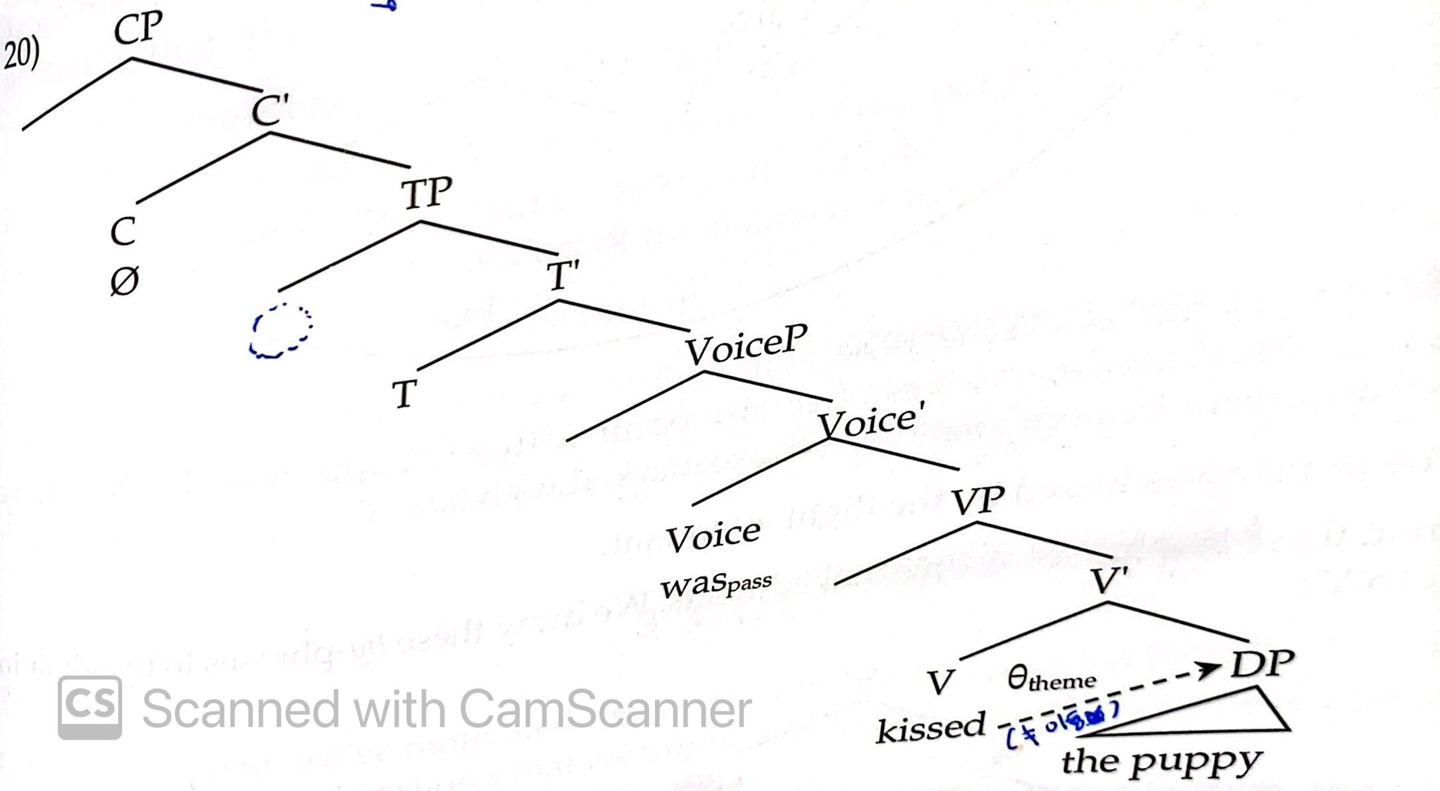
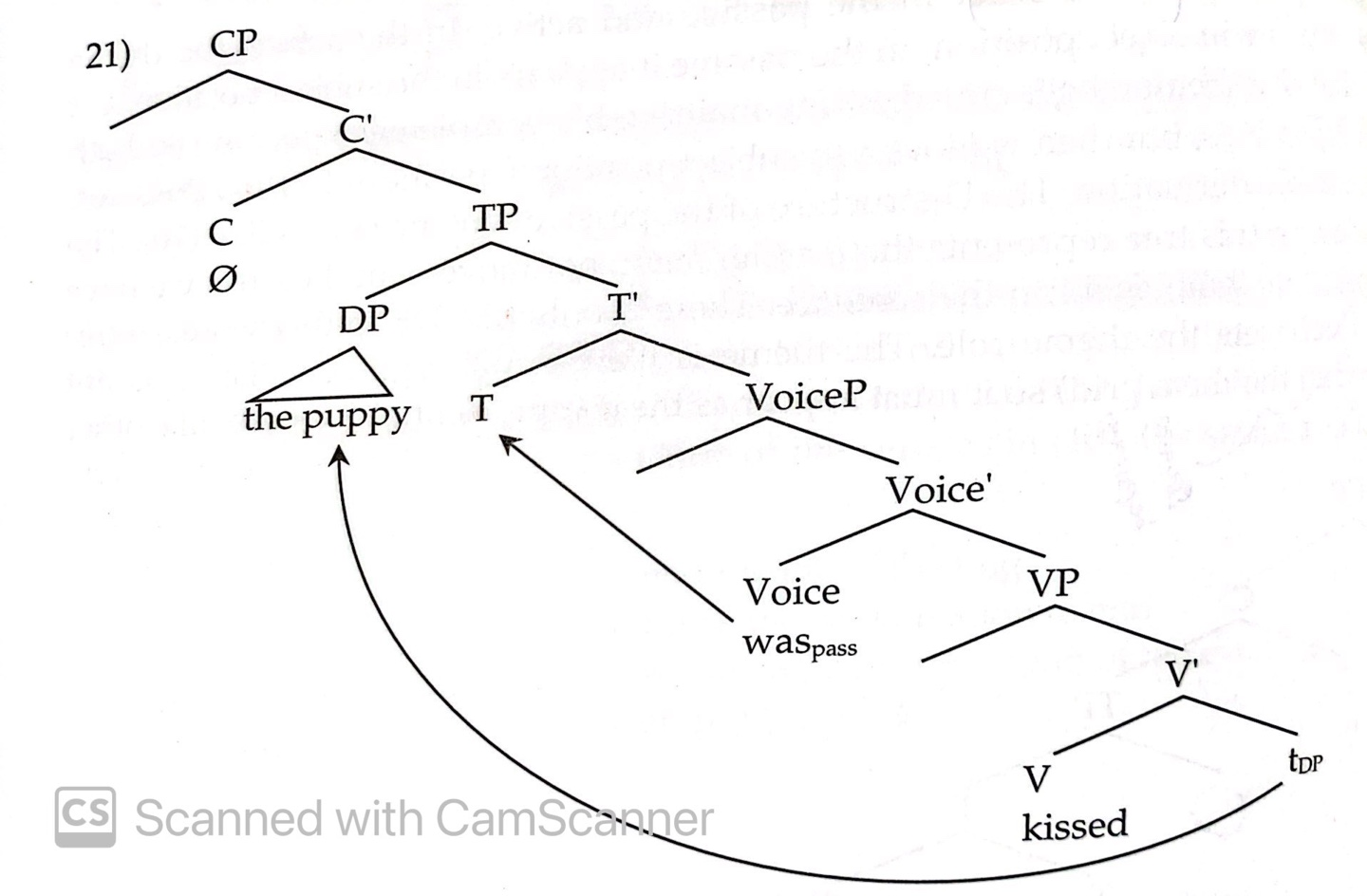
in the active, the theme arg appears in the object position; in the passive it appears in the subject position.

but "the theme is generated in the main verb's complement position in both actives and passives", but then is moved to subject position in passives.

theme위치가 능동/수동태일때 다른 게 아니라 둘다 verb의 comp자리에 나타난 게 시작인데 수동일 때 주어자리로 이동하는 것이다. 


왜? O/pass에는 agent없이 theme만 세타 그리드로 갖고, 이 DP는 verb의 comp자리에 위치한다. 근데 이렇게되면 EPP가 만족되지 못한다. 그래서 EPP만족시키기 위해 DP가 TP의 spec자리까지 올라간다. 


가끔 by통해 prepositional phrase넣기도 하는데, optional이므로 V의 adjunct로 넣어서 그린다. 


3. Case

기존의 설명들 가지고는

why "only subject DP" of an embedded clause can satisfy the EPP/ object DP may not move랑

why it isn't simply permissible to satisfy the EPP by inserting an expletive인지를

를 설명할 수 없다 ; 해결 : Case


case = morphology associated with grammatical relations.

grammatical relation : subject, object, indirect object같이 what represent how a DP is functioning in the sentence syntactically.

thematic relation : grammatical -과는 다른 것! represents meaning.


case의 대표 유형

1) nominative case ; which is found with subjects

2) accusative case ; which is found with objects

많은 언어들에서 각 케이스를 접사 등으로 구분하곤 하는데, 영어는 그런 식으로 구분 안되는 경우가 많고, 위치로 구분하곤 함(Jen likes Steve. Steve likes Jen.) (대명사는 구분되곤 함)

동사도 형태 null case suffix로써 1,2인칭 구분 안되기도 하는 등 형태 변화없어보이곤 한다. 그럼에도,

"all nouns get case" 

또한, "case should have a structural trigger". DP들은 "특정 위치에 나타나는 것만으로만" case 부여받을 수 있음.

; nominative case -> "finite" T의 spec / accusative -> (active!)transitive V의 sister / prepositional case -> assigned by preposition


case serves as our motivation for DP movement. 

case는 운전면허와 같다 ; DP needs a license to surface in the sentence. DP can only get a license(case) in specific places. 해당 자리에 들어와있지 않다면, 그곳으로 가기 위해 이동 필요하다. Case없는 DP는 이동 불가 

= "case filter" ; all DPs must be marked with a Case / if a DP doesn't get Case, the derivation will crash.


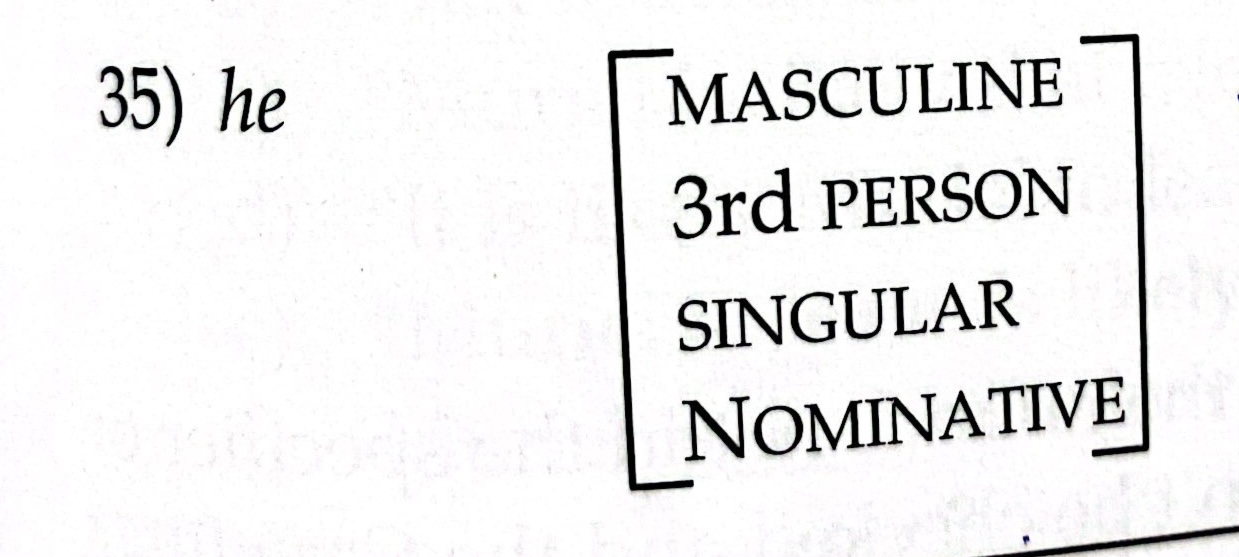
case filter실행시켜보기 위해 우리는 feature checking/valuation 진행한다. 

; 단어들이 atomic features들로 구성돼있다 했을 때, case받는 것도, 부여하는 것도

같은 atomic feature(accusative 또는 nominative)갖고 있고, 해당 부여하는 단어에 받는 단어가 "local"일때 성립(?)

feature check되려면 꼭 가까이에서 (local?) 있어야한다!

local인게 중요하다 not local이면 feature won't be "checked". case filter 위반!

4. Raising : Reprise

a) It is likely that M left. (embedded clause is "finite"일때, EPP를 expletive로 채울 수 있는듯)

b) That M left is likely. ("tensed clause" can satisfy EPP)

c) *M is likely that left. ("finite" clause's rasing 은 불가능!)

--> a~c) 이미 case를 finite T에서 받음. 다른 곳으로 이동할 이유없음! 따라서 이동한 c비문


*위에서 우리는 DP가 nominative case받는 경우가 finite T의 spec인 경우라고 봤었다. non-finite은 그렇지 못하므로 nominative Case 를 embedded clause의 spec으로 넣을 수 없다. 

d) *It is likely M to leave.(non-finite embedded clause나왔을 때 EPP를 expletive로 채울 수 없다)

e) *M to leave is likely. (non-finite clause can't satisfy EPP.)

-->d,e : M이 주어라는 case를 받을 수 없는 위치이다

f) M is likely (t i) to leave.(non-finite에서 raising 가능! case를 받을 수 있는 위치로 이동했다 finite main clause T로)


** DPs always move from positions where they can't check Case to positions where they get Case. f같은 경우

반대로 이미 case를 부여받은 경우는, 이동할 이유가 없으므로 이동하지 않는다. a~c같은 경우.


5. Passives:Reprise

위에서 말했듯이, accusative case는 active transitive verb만 부여할 수 있다. 

따라서 be pass는 [-ACC]의 feature을 가지고 있고, 즉 comp에 accusative case를 받을 수 없다!


따라서 원래 능동일 때 목적어였던 DP는, no case가 되었으므로, case filter를 만족시킬 수 있는 곳으로 이동해야된다. 


1) "be pass" doesn't assign an agent role 주어 없음 = finite T의 spec자리에 DP없는 상태 

(그니까 be pass는 theme은 theta grid에 있는데 목적격 case도 부여 못하고, agent는 갖지도 못한다는 소리지?)

2) its verbal complement can't assign accusative case목적어 부여못함

= case position open! theme DP can move to the spec of TP. 

=따라서, DP moves to get Case "from its caseless theta position" "to the nominative Case-assigning specifier of TP".

(수동태때는 spec TP가 accusative case부여하나봐)

결국 여기서 DP가 움직인 이유는, "EPP"만족과, "case 얻기 위해서"였다. 


6. inherently passive verbs : unaccusatives

많은 언어의 많은 동사들이 inherently passive하다. 즉 external(주어)없이 internal argument만 가지며, accusative case를 부여하지 못한다. (완전 수동태 동사 특. 근데 생긴게 그냥 능동사같이 생김(?))

She arrived at the palace. ; she가 주어위치에 와있지만, 사실 목적어 위치에서 case부여받으려고 raising한 theme이다. *agent는 아님. the box arrived에서 the box가 직접 무언가를 하게끔 고를 능력이 없잖아

*verb가 intransitive가 아닌 unaccusative인 이유 : 특징이 다름. intransitive는 선택적으로 목적어 가질 수 있는데, unaccusative는 못 가짐 (eg., Stacy danced (a jig). /* Stacy arrived a letter.). 어떤 언어에서는 int- unacc-의 aux다르게써서 구분하기도 함.


따라서 이런 식으로 트리 그리는데...

수동태처럼 epp만족과 nominative case받기 위해서 이동했다고 볼 수 있다!(긍까 수동태랑 똑같은데 be pass만 없을뿐아님?)

+이 트리에는 voiceP가 없다 ; no agent + not grammatically passive 라서 voiceP자체가 불필요.(이게 교수님이말한 voiceP불필요한 동사들일듯)

이런 단어들 뭐 있나?? : arrive, dance, ...


7. DP movement in SVO vs VSO lang

10장에서 우리는 주어 DP가 voiceP의 spec자리에서 최초 생성되고, 영어같은 경우는 T의 spec으로 이동한다고 보았었다.

왜그런지 이제 설명가능한데, all subject DPs move to the specifier of finite T "to get case". 케이스 부여받는곳으로 이동하고자! 그런것임

능동이랑 자동사문에서는 voiceP의 spec자리에서 출발하고, 수동은 "목적어 자리에서" 이동 출발하는것임.(목적지는 다 finite T의 spec으로 같은듯?)


svo랑 vso차이는 결국, case assign받을 수 있는 곳의 차이라고 볼 수 있다. 

영어같은 svo는 finite T의 "spec자리"에서 nominative의 case assigner가 가능했던 것이고

vso는 DP가 finite T한테 "immediately c-commanded할 때" case assign이 가능했다고 볼 수 있다.

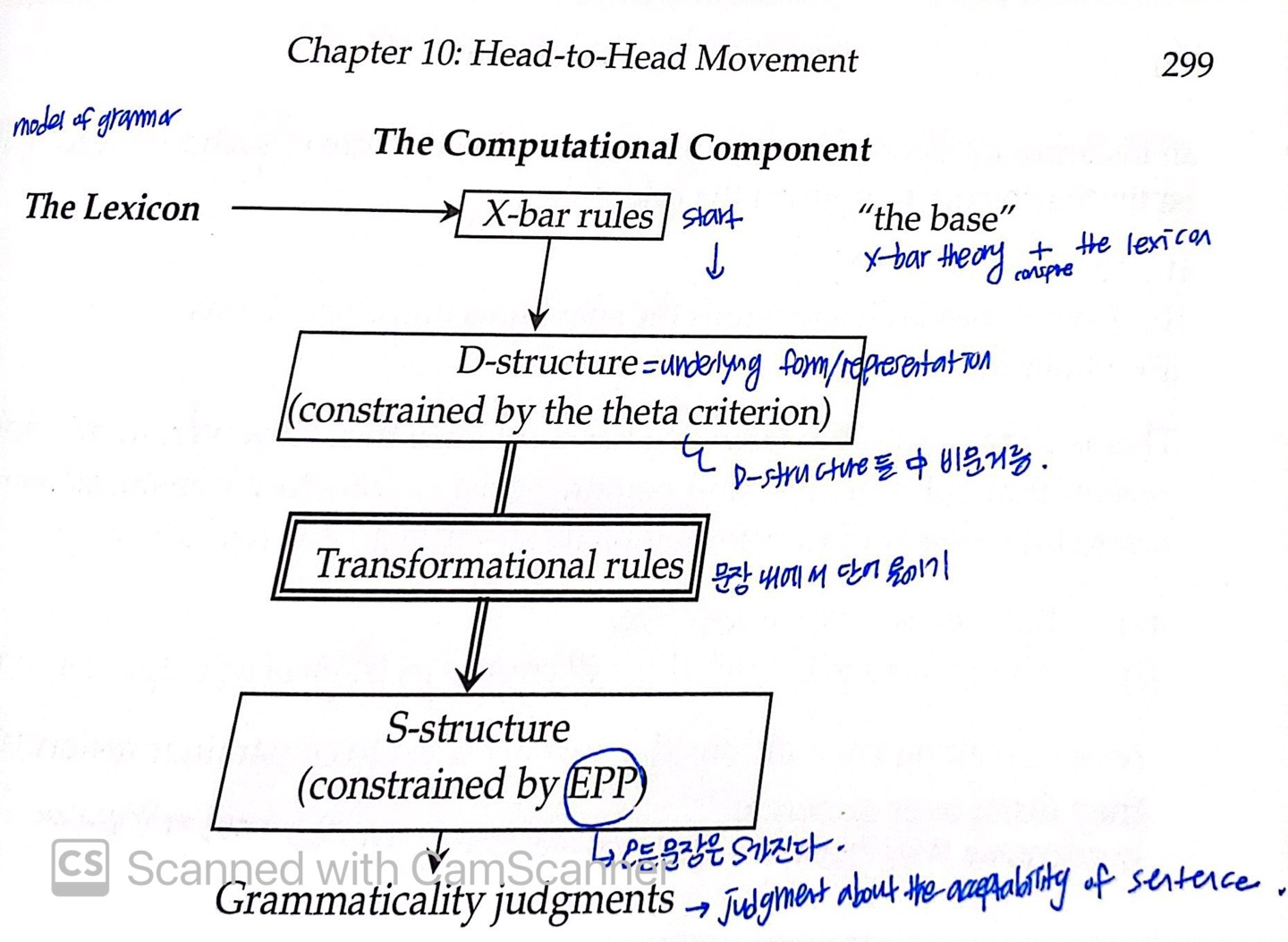
x-bar theory만으로는 표현불가능한, 표현하려하면 브랜치들끼리 꼬여버리는 언어(문장)들이 있다. 

이를 transformational rules로 해결해보자!


grammatical sentence가 만들어지는 과정(?)


two kinds of transformations 

1) movement rules : move things around in the sentence

2) insertion rules : put something new into the sentence


이 챕터에서는 movement rule중에서 head-to-head movement에 대해 배워볼거다!


1. Verb Movement (V->T)

1.1 French

프랑스어는 영어와 다르게 동사와 목적어 사이에 부사가 끼어있다.

I eat often of.the apples. (=I often eat apples)


1)우리가 배운바에 따르면 V' adjuncts(adv...) are predicted to invariably follow modals(can ...) that are instances of the category T.(T Modal) T뒤에 부사 옴

영어, 프랑스어만 일단 보면, 두 언어 다 tensed aux 경우에는 위의 slot을 잘 지켜서 T Aux 순서를 지키는데, 프랑스어는 T tensed verb도 순서 잘 지키고, 영어는 tensed verb T순서로 쓰였다.


2)프랑스어는, modal, Aux가 문장에 있는 경우에는 main verb가 adv뒤에 왔고

main verb만 있는 경우에는 main verb가 adv를 선행한다.


* 왜그럴까?

1) 언어마다 V->T rule적용범위가 다르다.

all langs have some version of the V->T rule, but they differ in how they implement it. Some set the parameter so that all [+V]s move to T, while others set it such that only auxiliaries raise.

2)verb movement (= verb raising, V->T movement) 때문!

: a special extra rule that moves verbs out of the VP around the adverb and into the slot associated with T. VP의 V를 adverb를 넘어 T로 이동시키는 규칙.

Verb movement parameter : All verbs raise(French) or only auxiliaries raise(English)

(+어떻게 V가 T로 이동가능할까? 잘 보면 tensed(시제로 인해 굴절된) verb만 T로 이동함. "tensed"라서(?))


이렇게 그리면 된다


12)번 문장의 t i = "trace" a silent element that sits at the D-structure position of the verb. 원래 있던 자리(?)


neg때도 역시 adv때랑 똑같은 규칙이 적용된다. (french는 aux, main verb모두 V->T이동, eng은 aux만 이동)

Not heads a projection called NegP, and this projection is the complement of TP, and dominates VP. 15)참고


1.2 Vata

(SOV문장인데 we eat rice같이 동사가 T자리로 이동하기도함. we have rice eaten같이 T 채워져있으면 SOV그대로 쓰고)

vata어 역시 마찬가지로 with the overt aux, the verb appears to the far right, presumably "its base position". (aux있으면 동사가 untensed라서 T로 안 감)

but when there is no aux, the verb appears in the structural slot occupied by the tensed aux, presumably "the T position".(aux없으면 동사가 tensed라서 T로 올라감)

*결국 verb가 tense feature가지고 있을 때 verb가 올라간다. : 여러 언어에서 aux랑 tensed V랑 같은 자리에 상보적으로 일어나는 것이 증거이다. we can have eaten rice (X)


1.3 Irish

Irish는 VSO언어이다. VSO langs are underlyingly SVO(at D-structure), then a transformational rule(V->T) applies that derives the initial order. 라는 규칙을 세워 VSO문장 설명 가능하다. 

Irish에도 V->T규치이 적용됐다는 증거는 aux랑 main verb가 상보적 분포를 갖는다는 것 외에도 많이 있다.


하지만 여기서 문제! V->T규칙이 적용돼서 V가 T자리로 올라가도 D가 T보다도 앞섰어서 여전히 VSO형식을 만족하지 못한다(여전히 SVO) : external arguments(subject) are not generated in the specifier of TP.(French, Eng은 그랬는데..) Instead, they are "underlyingly generated lower in the tree, after the T node.


해결 : voiceP-internal subject hypothesis :사실 DP의 자리가 그곳이 아니기 때문.DP 자리는 voice head 의 specifier이다.

즉, 능동태이더라도 수동태처럼 voice head를 가지고 있다고 보자. eng은 우연히 active voice head가 null이어서 우리가 잘 몰랐던 것이다(다른 언어들 중에는 null아닌 경우 많다)

따라서 능동태면 voiceP의 DP자리가 채워지고 Voice자리가 null이며, 수동태면 voiceP의 DP자리가 없고 Voice가 채워진다.


*그런데 다른 언어들은 DP가 T앞이었잖아! 사실 그게 movement에 의한 거였다..

subjects DPs move from the specifier of the VP to the specifier of TP.


2.부터는 읽어보자...

8장의 이론의 적용대상을 좀더 확대해보자!

9장을 책을 잘 읽어보자..여기는 내가 헷갈릴만한것만 정리함..


1. complementizers


동사들에 따라 뒤에 오는 comp의 종류는 매우 다르다. = there are a number of subcategories of verb that are sensitive to the kinds of CP that they take as arguments.(8장에서 VP가 DP에 대해 까다롭게 갖듯이 CP도 까다롭게 갖는다?)

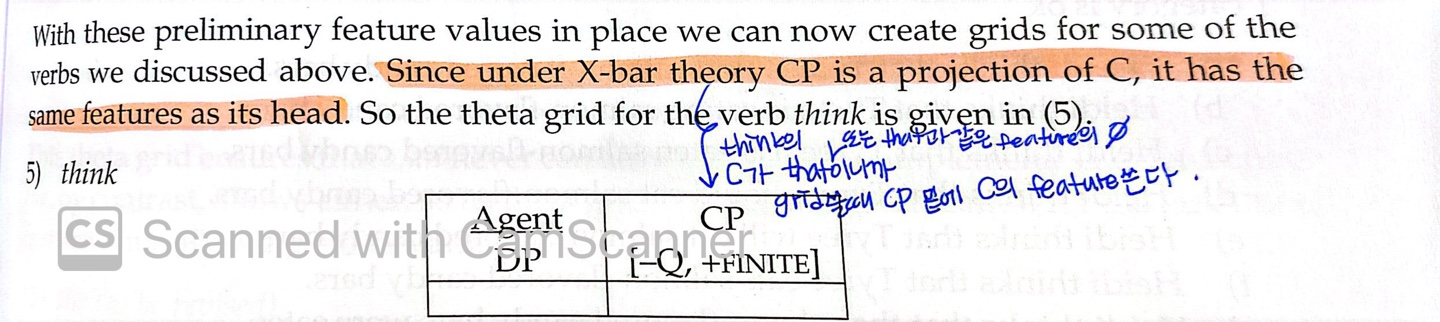
think뒤의 clause = +finite, -question, overt(명시적인) comp 없어도됨, uses 'that' ...

order = finite/non-finite둘다 가능, -question ....

inquire = interrogative(질문)만 가능.


다는 아니지만 몇개의 comp에다가 feature value 배정해보자.

that : [-Q, +FINITE]

O/ [-Q, +FINITE] :  [-Q, +FINITE]

for :  [-Q, -FINITE]

O/ [-Q, -FINITE] :  [-Q, -FINITE]

if/whether :  [+Q, +FINITE]

*O/ = null complementizer. alternants of overt ones, so have the same features but we can't hear.

7장에서 정리했듯이 모든 clause는 complementizer를 갖는데 소리가 안날수도 있다. 이 소리가 안나는걸 O/로 표현했고, 이 O/가 대체한 명시적인 comp의 특징을 따라간다.


동사의 theta grid에 적용하면...


다른 동사 예시들은 268페이지에서 참고하자. 

+-finite를 theta grid에 포함하지 않았다면, 해당 동사는 둘다 CP로 가질 수 있는 것이다.


comp들도 종류 매우 다양해서 뒤에 오는 clause의 스타일들이 되게 다르다.

e.g., that : declarative clause따라옴(서술문) , if/wheter : embedded caluse..


theta grid에 기록되는 뒤에 나오는 "TP"도 +-INFINITIVE로 구분할 수 있다.

+INFINITIVE인 TP는 to가 유일하고, 나머지는 다 (-)이다. 즉 뒤에 to라는 TP가 오는 것이 가능한 comp만이 theta grid에 

TP / [+INFINITIVE]라고 적을 수 있는 것이다.

+TP의 feature인(?) infinitive랑 comp의 feature인 +finite랑 헷갈 노노하기


2. Determiners

이번에는 D의 feature를 나눠보자.

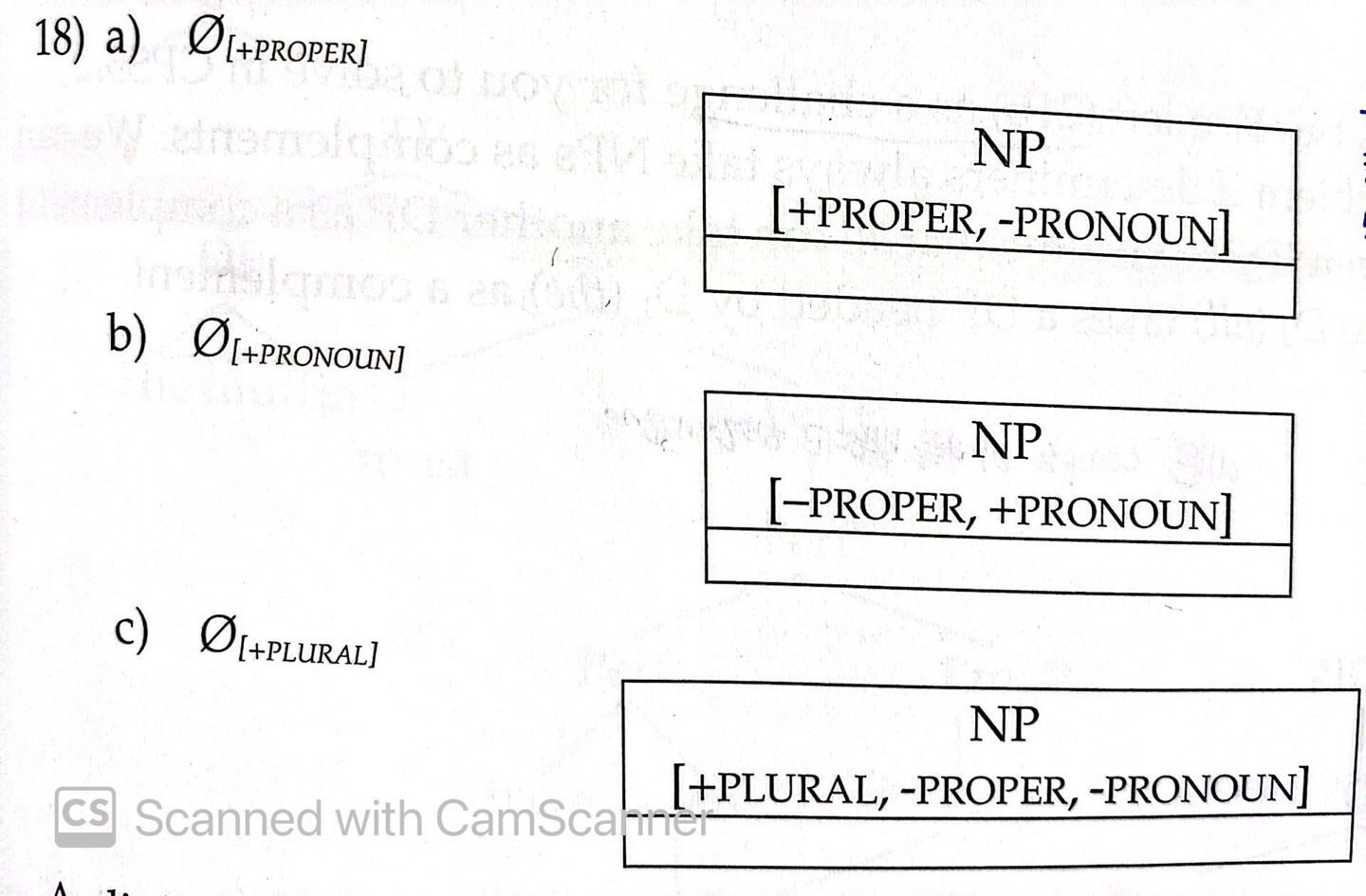
feature로는 +-PLURAL, +-PROPER, +-PRONOUN, +-COUNT등이 나올 수 있다.


a/an -> NP [-PLURAL, -PROPER, -PRONOUN] // the -> NP[-PROPER, -PRONOUN] plural은 +- 둘다 가능해서 생략!!


7장에서 우리는 모든 NP가 다 determiner를 갖는다고 했다. 하지만 D가 안보이는 NP들도 있으니, verb의 theta grid를 쓸 때 DP대신 {DP/NP}로 쓰면 어떠냐고 생각할 수 있다. 

하지만 그러면 비문도 허락할 수 있게 돼서 DP만 된다하고, D가 안보이는 것은 null determiner이 존재한다고 설명하는 것이 낫다. --> Carpenter struck the nail (x) "the carpenter"이 되어야 한다. 따라서 null determiner에 feature를 한정해서 carpenter은 null determiner를 못갖게 하는 것이 필요하다.


...이렇게 되면 carpenter를 NP로 가질 수 있는 O/없음!


many -> NP[+COUNT, +PLURAL, -PROPER, -PRONOUN] // much -> NP[-COUNT, -PLURAL, -PROPER, -PRONOUN] 


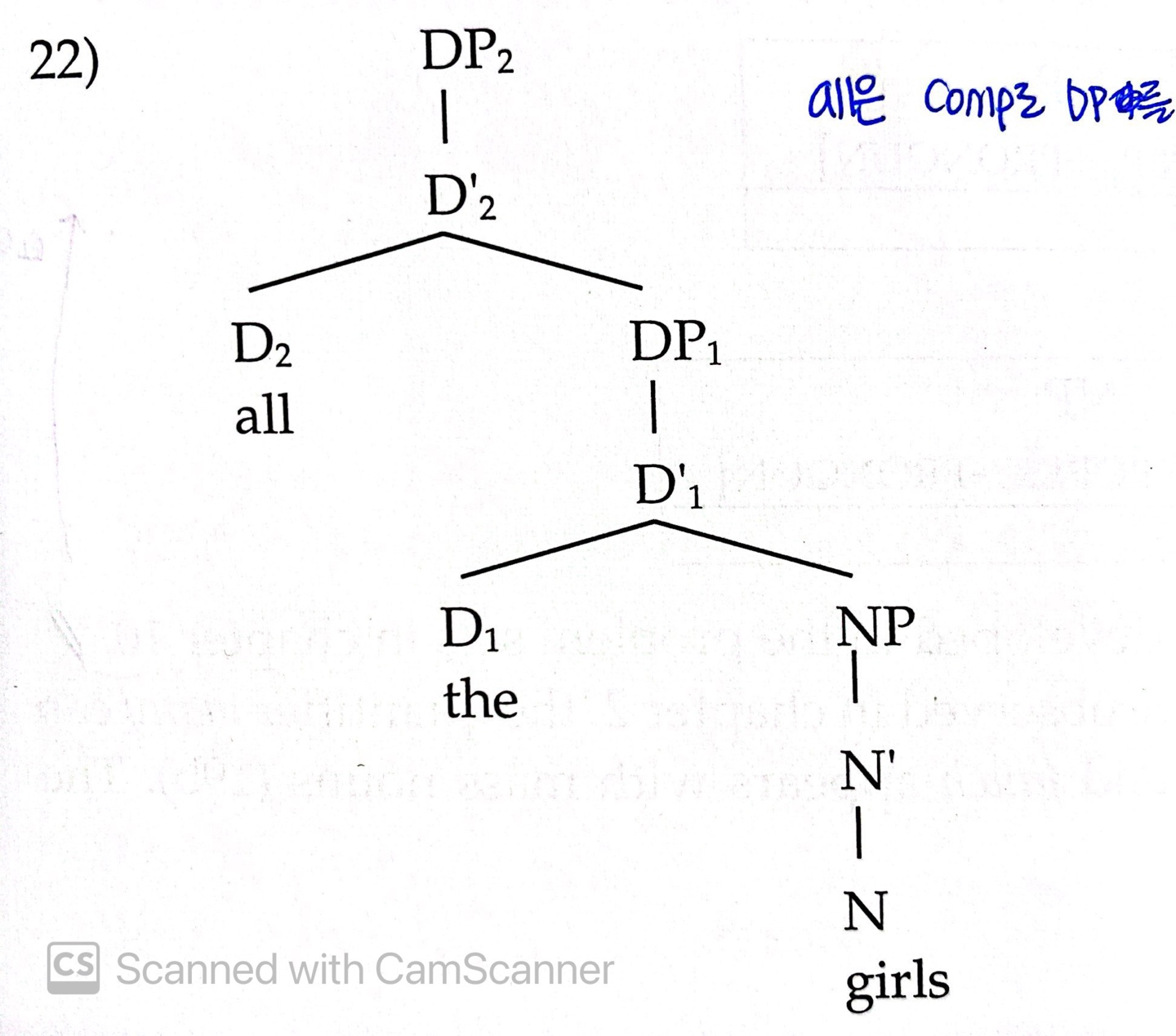
원래 D는 noun당 하나 나오는거 알지? 그런데 D가 두 개 이상 나오는 예외적인 경우가 있다. 

1) D중에 quantifier "all"(all the girls) , 2) numerals(the three girls)--challenge문제..ㅅㅂ

1)해결방법! all은 comp로 NP가 아니라 DP를 받는다고 한다!

3. using theta grids for english auxiliaries and modals

mood, tense, aspect, voice와 관련된 표현은 복잡한데, 그 이유가 한 덩어리가 아니라 not contiguous하기 때문이다 

예를 들어, perfect aspect나타내기 위해서는 aux had 와 suffix -en+verb의 combination이 이루어진다. 


지금까지는 tree그릴 때 affix lowering으로 그렸지만, 모든 완료/진행/과거형이 -en/-ing/-ed가 붙어서 나타나는 게 아니고 불규칙형도 있기 때문에 문제가 생길 수 있다.

그리고 영어 aux string에는 strict ordering of elements가 있지만, affix lowering(x-bar theory)으로는 뒤에 이어지는 functional elements들 사이의 순서를 설명할 수 없다.

--> 이를 theta grid로 고쳐보자!


274 3.1

...여기부터는 책 읽어보자 꼼꼼히!

modal(should, will, have, must...) : [+V, FORM bare]

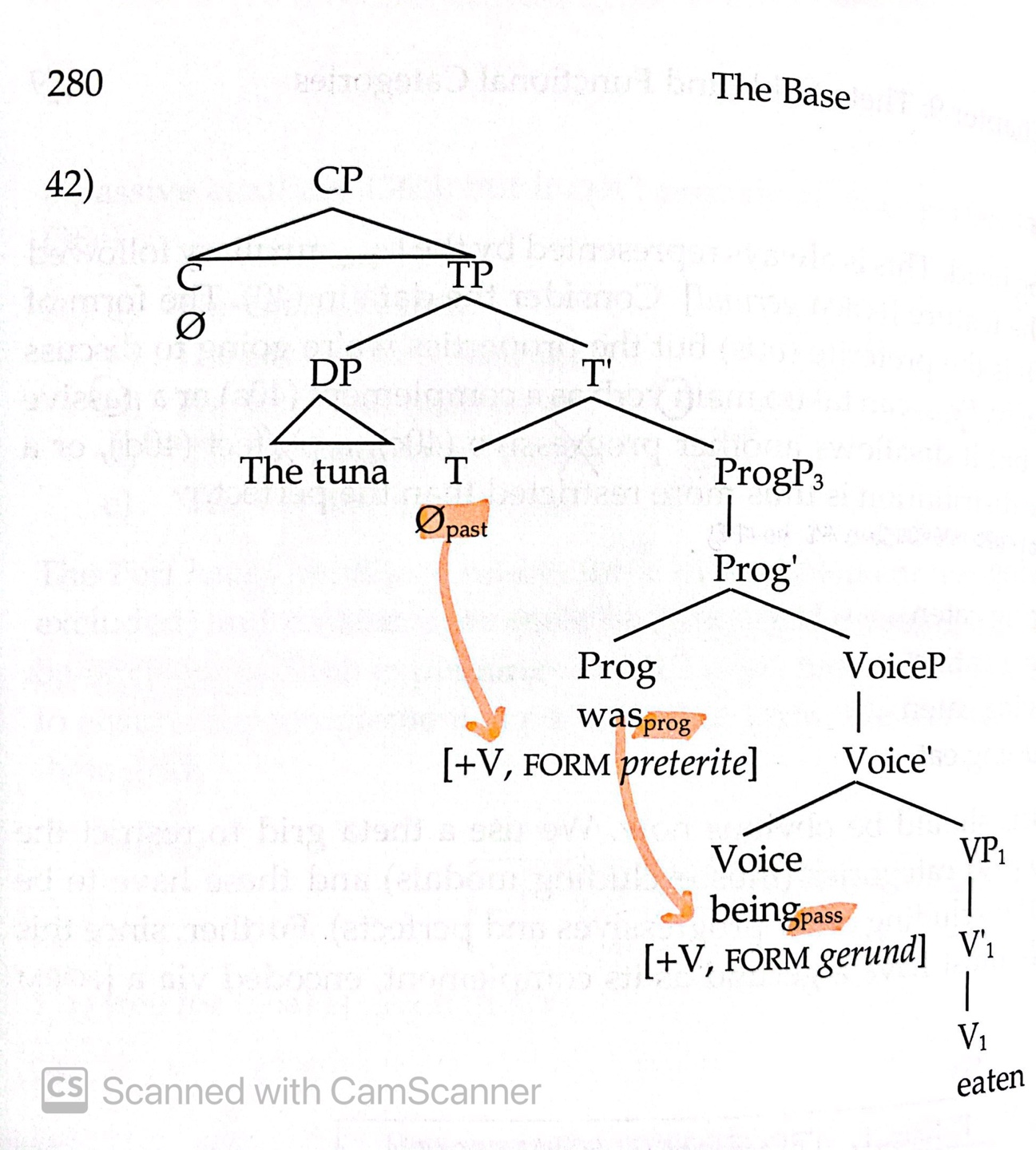
T중에서 present,past node : O/ [+V, FORM preterite/present]

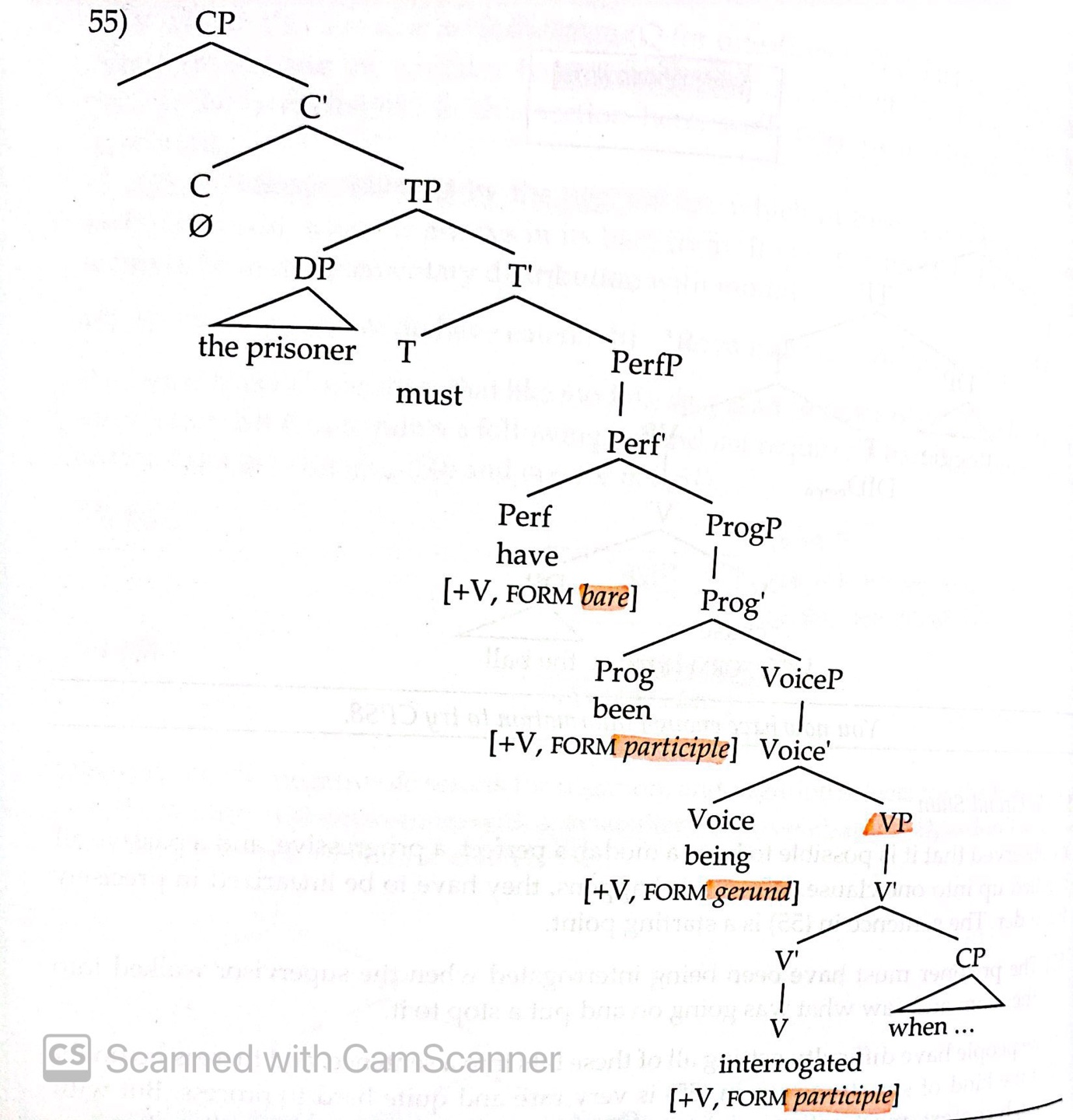
have perf : [+V, -PERFECT(뒤(comp)에 완료형 또 못옴), FORM participle]

be prog: [+V, -PERFECT(뒤에 완료형 못 옴. 앞에 왔어야됨), -PROGRESSIVE, FORM gerund]

be pass: [+V, -PERFECT, -PROGRESSIVE, -PASSIVE, FORM participle]


* will 과 같이 현재, 과거형도 tense가지는데, silent한 O/의 형태로 나타난다고 하자. 

따라서 affix lowering처럼 -ed, -es는 T가 아니라 T의 theta grid의 V의 형태로 나타낸다.[FORM preterite(과거) /gerund(진행)/present/participle(완료)/bare(원형)]

comp의 특징[+V, ...]을 해당 preterite?아래에 써줌...

3.6 Do-support

do 가 나타나는 세가지 환경

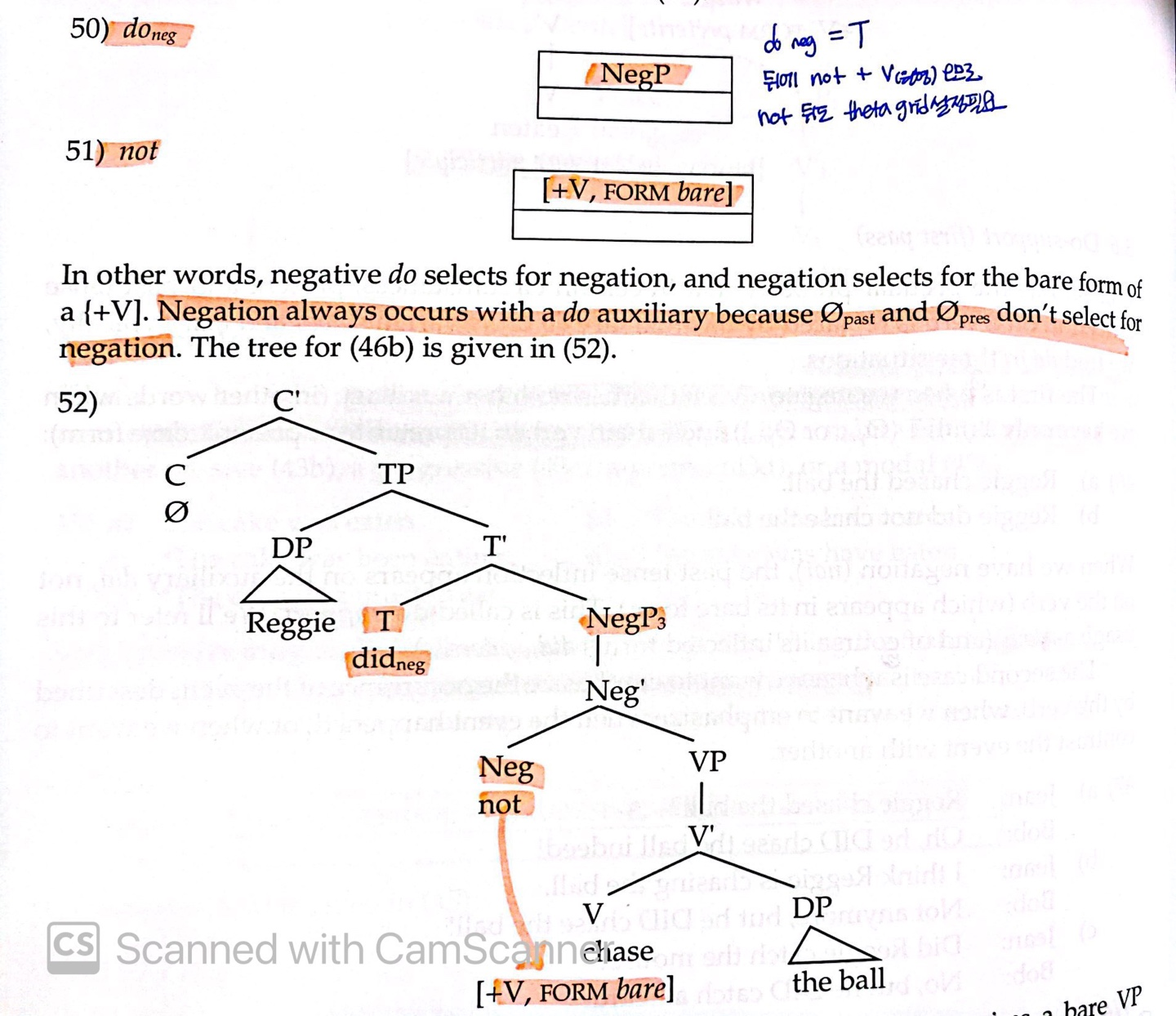
1)do/did/does neg: when we negate a verb that has no other aux. = we only have (a null T(O/past or O/pres)) and (a main verb in its preterite or present tense). 


이때의 Do neg는 항상 negator not을 따라가고, 동사원형이 do를 따른다. 

우리는 Do neg를 T로 정의하고, do neg 뒤에 NegP가 따라오고, not 뒤에 [+V, form bare]이 따라온다고 theta grid를 그릴 수 있다. 

2) do/did/does emph : when we want to emphasize. 

Do emph --> [+V, form bare] 간단! 이때 do 역시 T이다.


3) the set of forms that are used in Q.나중에 배우자


총정리 :


4. Main verbs VS Auxiliaries

have, be, do가 항상 aux로 쓰이는 것은 아니다! main verbs로도 쓰일 때 있다.


윗줄 has the flavor of lexical verbs, 밑줄 is aux.

main verb = V, aux= T, perf, prog, voice...

1) the verb "have"(have poss) = indicates "possession". it is followed by a DP

aux "have"(have perf) = lack the semantics of possession. followed by the participial(분사형) form of the verb


2) copular "be" (be cop)= indicates membership in classes or expresses identity. followed by a noun

aux be (be prog, be pass)= used for progressive and passive. followed by verbal forms


3) verb "do" (do main)= means accomplish / perform. followed by nouns

aux "do" (do aux)= followd by (negated) verbs. meaningless. supports tense.
 

aux는 subject와 자리 바꿀 수 있다. (Has Maya ate a bowl?) main verb로는 바꿀 수 없다 (Has Maya a bowl?(x))

aux는 not앞에 나올 수 있다. main verb는 negation앞에 나올 수 없다. 


'syntax' 카테고리의 다른 글

syntax ch.11 DP movement  (0) 2022.12.04
syntax ch.10 Head-to-Head Movement  (0) 2022.11.16
syntax ch.8 Constraining X-bar: Theta Theory  (0) 2022.11.07
syntax ch.7 Extending X-bar to functional categories  (0) 2022.10.24
syntax ch.6 X-bar theory  (0) 2022.10.11

+ Recent posts